 ____________________________
 __________________________

 “In towns and cities... there is no more important institution than the local paper.”
Warren Buffett
“In towns and cities... there is no more important institution than the local paper.”
Warren Buffett

:
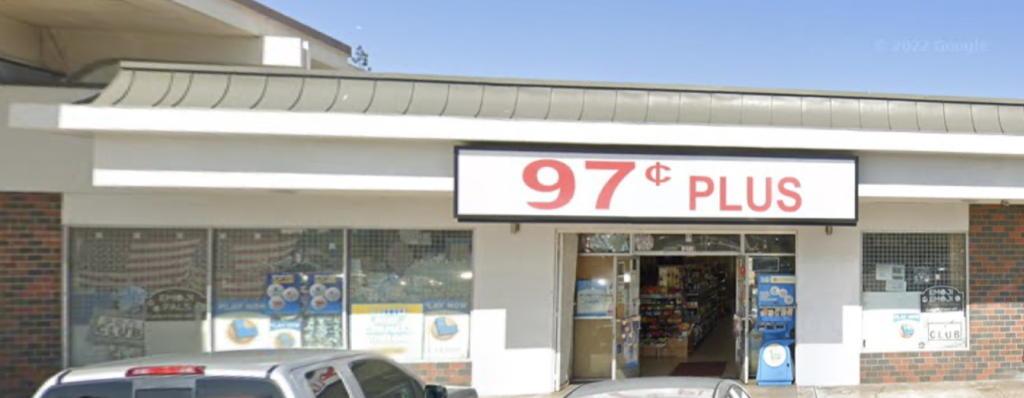
A 97¢ Plus discount store in La Mirada. The City Council is advancing new rules governing discount stores as the city's moratorium approaches expiration.
September 28, 2026
By Vincent Medina
The La Mirada City Council on Tuesday authorized a traffic signal at Rosecrans Avenue and Stanton Avenue after a study found the intersection met one of nine state tests for a light, and directed staff to send new discount-store rules to the Planning Commission before a two-year freeze on those shops expires in December.
Rosecrans Avenue is defined as a major arterial in city documents, with two lanes of traffic each way and a speed limit of 45 mph. Stanton Avenue is a neighborhood street, with a speed limit of 25 mph and a stop sign where it meets Rosecrans Avenue.
Eastwood Elementary and the Los Coyotes fields at El Camino High School sit off Stanton. The city has painted yellow school crosswalks and drops the speed limit to 25 mph to make the area safer for students.
Residents have been asking for a signal since winter. The city’s traffic commission ordered a traffic study in April.
The study found speeding was not the primary issue under the city’s analysis. Counters on Rosecrans Avenue logged about 19,000 cars in a day. Most were traveling 49 mph or less on a 45 mph street. Staff said that is high, but still in the range they expect. Only 3% were going 56 mph or more.
The California Manual on Uniform Traffic Control Devices lists nine warrants for a signal. Satisfying one is enough for a city to consider installation. It does not, the staff report said, “automatically indicate the requirement” of a light.
The intersection passed the volume test. During a test in April, Rosecrans Avenue saw more than 1,100 cars an hour in the afternoon, rising to about 1,760. Stanton Avenue, the smaller street, saw about 120 to 160 cars an hour on its busier approach. That pairing is high enough under state rules.
The other tests failed, including walking counts, the school-crossing test and crash history. Staff is recommending the light because of how many cars use the intersection, not because of a crash record.
“The kind of the driver, I guess, for the need for the intersection, a signalized intersection, isn’t so much speed, but actually the traffic volume,” City Manager Jeff Boynton said.
Councilmember John Lewis asked whether more inexpensive tools had already been tried. A radar trailer had been posted at the corner. Traffic engineer Bill Zimmerman said those signs work until drivers stop seeing them.
“That’s very useful, but the longer it’s out there and deployed, the more it becomes background and ignored,” Zimmerman said.
Motorcycle enforcement, Zimmerman said, lasts a week or two and then the old pattern returns. A crossing guard is already there on school days.
Boynton estimated the traffic signal would cost about $700,000. He said Measure R, Measure M and Proposition C money the city already uses for streets and signals would be eligible.
The Public Safety and Traffic Commission had voted unanimously on Aug. 27 to recommend the light.
The council unanimously approved the installation of the traffic signal at Rosecrans Avenue and Stanton Avenue.
Discount-Store Rules
The City Council later addressed the city’s discount-store freeze.
Those shops are not their own land-use category in the municipal code. They have been treated as ordinary retail, which means they can open in commercial zones.
The council imposed a temporary ban on new stores and expansions on Dec. 10, 2024, and extended it twice, through Dec. 8, 2026.
Staff counted nine existing discount stores in the city, with seven on Imperial Highway.
A Sept. 8 study session had pointed staff toward a cap of one new discount store per shopping center, down from a draft cap of three, and toward letting existing stores stay.
After consulting the city attorney, Community Development Director Manuel Muñoz came back with a different approach. A fixed number, staff said, presented legal problems. A conditional use permit would instead allow the Planning Commission to weigh each proposed new store against the shopping center around it.
Existing lawful stores would be allowed to continue operating. They would not need a conditional use permit simply because the law changed. They would receive a zoning clearance, document existing conditions and have one year to meet new rules covering shopping carts, loading, displays, litter, graffiti, landscaping and signs.
Existing stores could lose that protection if they expanded in a major way, changed operators, fell out of compliance or ceased operations for 60 consecutive days.
Stores that devote at least 75% of their merchandise display area to food and non-alcoholic beverages would not need a conditional use permit and would instead receive a zoning clearance. Alcohol, tobacco and nicotine products would not count toward the 75% threshold.
Lewis said he wanted a tighter review.
“I like the CUP (conditional use permit) aspect; it gives us more control over it,” Lewis said.
He asked whether those permits stop at the Planning Commission. Staff said they would, unless someone appeals the decision to the City Council.
Mayor Anthony Otero thanked staff for “developing this legally defensible approach.”
“I’m very comfortable with this approach,” Eng said. “The permit kicks up the threshold from admin review to case by case.”
Eng continued, “Concentration, retail mix, compatibility, and maintenance are legitimate concerns, but they are best addressed when we have an actual proposal in front of us, not in the abstract.”
Councilmember Michelle Bean thanked staff for including provisions addressing shopping carts, landscape maintenance and pedestrian walkways.
Otero used a faded sign as an example while asking whether the maintenance requirements would apply to stores already operating. A shop on Telegraph Road, he said, still advertises “99 cents” on the building.
He also asked staff to state explicitly in the maintenance section what the operating section already said: that the same standards would apply to existing establishments. Staff agreed to make the two sections consistent.
Stores already operating would be allowed to remain. Staff would give each store a list of items that must be corrected. Some issues, such as old signs, would have to be addressed immediately, while other improvements could be completed within one year.
The Planning Commission will hold a public hearing at an upcoming meeting on the two proposed amendments.
If recommended by the Planning Commission, the amendments are scheduled to return to the City Council for a first reading Oct. 27 and a second reading Nov. 10. The new regulations would take effect Dec. 10, two days after the current discount-store moratorium expires.